Deshen Weekly
What Is the Kingdom of God, Really? Part 2: Why God's Rule and Human Rule Collide
God's kingdom and human kingdoms in Daniel, Israel, politics, and daily life.

Brethren,
Last week, we saw that God's kingdom is His active rule: His power carrying out His will. I promised to come back to two questions.
- How can the kingdom be here and still be coming?
- And how does it relate to human kingdoms?
Few things cause more confusion about God's kingdom than its link to human kingdoms. When people hear the word kingdom, they often picture a human king, a government, and a piece of land. Some even say God's kingdom cannot be here yet because Jesus is not now sitting on a throne on earth.
So let me ask you: Is God's kingdom here now, still to come, or both?
If you said both, you are right. But how can it be here and still be coming? We are looking at the kingdom from two sides. Jesus brought God's rule near when He came, and one day that rule will be seen in its fullness (Mark 1:15; Luke 17:20–21; Revelation 11:15).
If you see this, you may never look at the kingdom of God the same way again.
Daniel's picture of the kingdoms
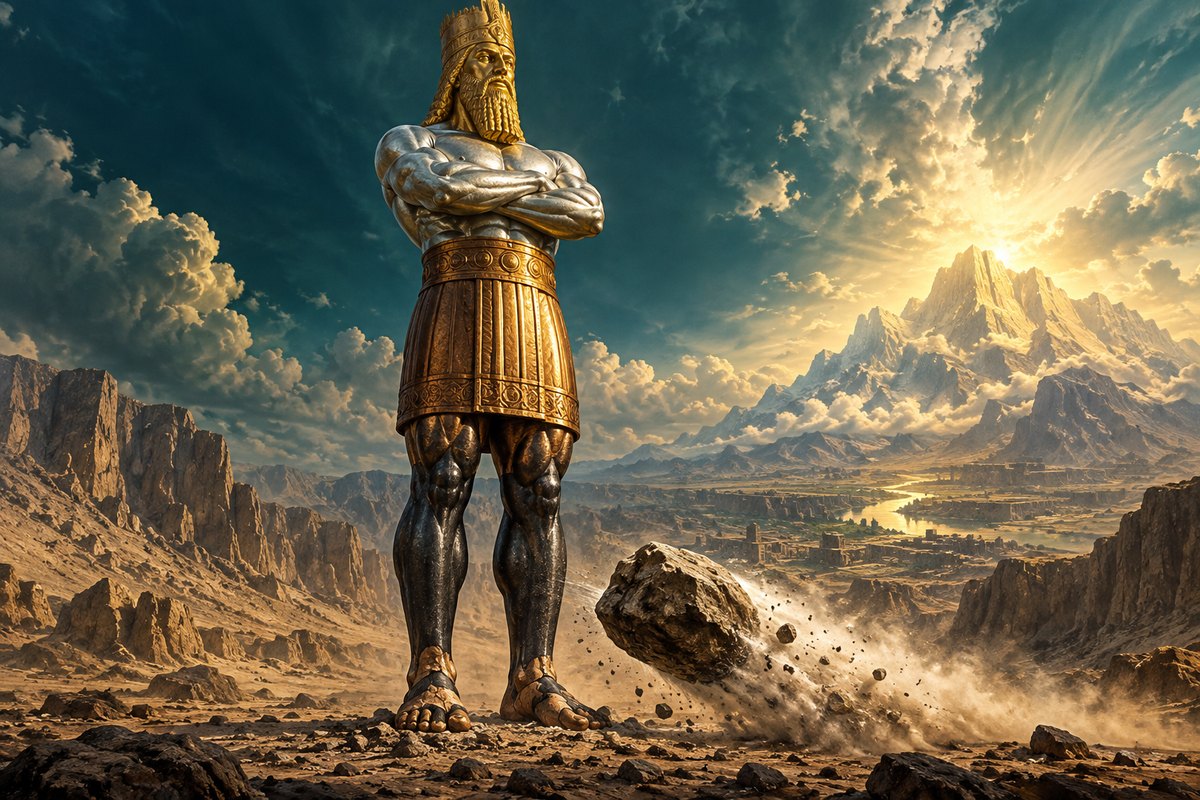
I believe Daniel is one of the most important books for understanding how God's kingdom works among human kingdoms. If you have never read it from start to finish, I encourage you to do so.
I have listened to it in different versions on long drives. At times, I have listened to it more than ten times. I keep seeing more in it.
In Daniel 2, King Nebuchadnezzar had a dream. He saw one great human image.
- Its head was gold,
- its chest and arms were silver,
- its belly and thighs were brass,
- and its legs were iron.
- Its feet were iron mixed with clay.
Then a stone, cut out without hands, struck the feet. The whole image broke apart, and the stone became a great mountain that filled the earth (Daniel 2:31–35).
Daniel said the parts pointed to kingdoms that would rise one after another (Daniel 2:36–43). Many Christians, including me, understand them as Babylon, Medo-Persia, Greece, and Rome.
I believe God showed Daniel these kingdoms before they came. In fact, his prophecy is so accurate that some scholars date the book later. They cannot accept that Daniel could have described these empires before they rose.
But I believe he did. To me, it points to one truth: there is a God who knows the future.
But now let me show you the mystery that is easy to miss. Daniel spoke of four kingdoms. What did Nebuchadnezzar see? One human image. He did not see four people standing in a row. He saw one person, and Daniel said its appearance was terrible (Daniel 2:31–33).
The four parts tell us about four empires. But the single image carries its own message. I believe it represents the kingdoms of men as one kingdom of men. Babylon, Medo-Persia, Greece, and Rome came one after another.
Other kingdoms can exist at the same time in different parts of the world. Yet, in this picture, they are all part of one human image. They are different kingdoms, but they belong to the same world of human rule.
Do you see it? Empires often try to bring many nations under one ruler. Nebuchadnezzar was a striking example of human kingdoms gathered under one powerful king.
But even when no single emperor rules the whole earth, I believe God sees the kingdoms of men together as one human kingdom. The rulers change. The countries change. The desire to rule by human power remains (Daniel 2:31–43).
Daniel gives us another glimpse of this. He says the saints “possessed the kingdom” (Daniel 7:22, KJV). Notice that kingdom is singular. I understand that to mean the saints receive the rule that human kingdoms had held on earth.
Revelation speaks of “The kingdoms of this world” in the plural (Revelation 11:15, KJV). One passage views the kingdoms of men as one whole; the other speaks of their many parts. Both views matter.
The stone and the clash
There is more. In the dream, all four kingdoms appear in that one image at the same time. In history, they came one after another. Babylon fell before Greece rose. Greece fell before Rome took power.
Yet Nebuchadnezzar saw them all standing together. Why?
Then a stone, cut out without hands, struck the image at its feet. The iron, clay, brass, silver, and gold were all broken together and blown away (Daniel 2:34–35). Daniel says the stone points to a kingdom God will set up, a kingdom that will never be destroyed (Daniel 2:44–45).
Here is the question. When Jesus came, Rome was ruling. Babylon, Medo-Persia, and Greece were no longer ruling empires.
So why did the stone break their parts of the statue too? Why did the gold, silver, and brass fall along with the iron?
Because the stone did not strike Rome alone. It struck the one image. In God's sight, those empires were parts of the same kingdom of men.
Their political reigns ended at different times, but the human pattern of rule they formed was still standing. That is why I believe God's kingdom came during Rome's reign and yet challenges every human kingdom, past and present.
And the stone was cut out without hands. God's kingdom did not come from the same source as those human empires (Daniel 2:34, 45). Jesus told Pilate, “My kingdom is not of this world” (John 18:36, KJV).
Picture yourself watching the dream. A stone comes toward a great human statue and strikes its feet. It looks like an attack.
If you saw two human empires clash, you would expect armies, swords, and blood. But here, two kingdoms from two different realms are meeting in a strange war.
Jesus came while Rome ruled. He preached the kingdom of God in the middle of that empire. After Him, His disciples preached the same kingdom.
Did they raise an army to fight Rome? Did they demand that Rome make Jesus its emperor? No. Jesus said that if His kingdom were of this world, His servants would fight for Him (John 18:36; Acts 8:4–12; Acts 28:30–31).

The kingdoms of men use armies, laws, and force.

God's kingdom moves through His Word, faith, righteousness, and the power of the Holy Spirit.
It reaches people and changes hearts. This is a real clash, but the stone does not break the human image by human methods. Its weapons are not the world's weapons (Ephesians 6:10–18; 2 Corinthians 10:3–5).
When people tried to trap Jesus with a question about Caesar and taxes, He gave Caesar his place and God His place (Matthew 22:15–21). There is a place for human government. It matters. But we make a serious mistake when we confuse God's kingdom with political power.
We can also make the opposite mistake and act as if politics never matters to Christians. Laws affect our neighbors and shape public life. We should care, act with wisdom, and serve where God calls us.
Yet no election, ruler, or law can do what only the Holy Spirit can do in a human heart. We need kingdom balance.
God was Israel's king
Now let us look at Israel. This is where the link between God's kingdom and human kingdoms becomes even clearer. Scripture says the Most High rules over human kingdoms and gives them to whom He wills (Daniel 4:17).
So human rule did not appear outside His knowledge or authority. Yet the way people use that rule today is far from what He first desired.
Before Saul, Israel had judges, but no human king like the nations around them. Now let me ask you a question: Was Israel a kingdom before it had a human king? You might be tempted to say no. But yes, it was. Who was the King? God Himself (Judges 8:22–23; 1 Samuel 8:7).
There were leaders, but no human monarch on a throne. God was reigning over His people on earth. That is a picture of the kingdom of God among men.
You may ask, Did God only start speaking of a kingdom after Israel asked for a king? Not at all. Before they even entered Canaan, He called them a kingdom of priests (Exodus 19:5–6). Revelation also speaks of God's people as kings and priests (Revelation 5:10).
God already had a kingdom in mind. Israel was to show His rule without copying the royal system of the nations around them.
Then Israel looked at the other nations and asked for a king like theirs. God told Samuel, “they have rejected me, that I should not reign over them” (1 Samuel 8:7, KJV). He warned the people that such a king would take their sons, daughters, land, and goods. Still, they insisted (1 Samuel 8:10–20).
I believe this was not the kind of kingship God first wanted for them. They wanted their kingdom to look like a human kingdom. God gave them what they asked for, and the whole nation's life became tied to its king. Some kings led them well; many brought them pain.
Yet God did not abandon them. He worked through that human throne. He raised up David and made a lasting promise to his house (1 Samuel 8:19–22; 2 Samuel 7:12–16). God was still King, but now He was also carrying out His purposes through Israel's human kingdom.
Think about David and Bathsheba. Their story began with adultery, the death of Uriah, and deep pain. Yet Solomon came from that family story and became a king known for wisdom (2 Samuel 11–12; 1 Kings 1:28–30; 1 Kings 3:5–12).
That does not excuse David's sin. It shows the mercy of God. He can bring light into places marked by our worst choices when we turn back to Him.
Brethren, that is our God. Even when sin and weakness have made a mess of our lives, He calls us to listen, repent, and obey. He can bring hope into the places we are ashamed to show Him (Psalm 51:1–12; 1 John 1:9).

So I see two stages in Israel's story. Do not miss the difference:
- God was their king, and they lived as His people without a human monarch (Exodus 19:5–6; Judges 8:22–23).
- God remained their true king, but His rule was now expressed through the human system of kings that Israel had requested (1 Samuel 8:7–22; 2 Samuel 7:12–16).
That human throne had a danger. Samuel warned that kings could take and control. Jesus later said that rulers of the nations exercise power over others, but His people must lead differently (1 Samuel 8:11–18; Luke 22:25–26).
Remember the frightening image in Daniel's dream? It is a strong picture of what human power can become when it is cut off from God's heart (Daniel 2:31). But God has always had a better way.
What God gave humanity to rule

Go back to the beginning. God made both man and woman in His image and gave them authority over the earth and its living creatures (Genesis 1:26–28). The psalmist also says God put the works of His hands under humanity's feet (Psalm 8:5–6).
That was the beginning of human rule. Dominion was God's gift before people built thrones, palaces, or governments.
Notice what Adam and Eve were given to rule: the works of God's hands. God did not tell Adam to rule over Eve. His original gift of rule was not a license for one person to dominate another. That is what sin has done to human power.
The human kingdoms we know today are a broken expression of that original gift.
God still has authority over rulers and can use government for good (Daniel 4:17; Romans 13:1–4). But fallen people often use power to control and hurt others.
Here is something I want you to think about. God made us in His image and gave us a calling to rule. Many of us feel a desire to rule, control, and exercise dominion. That desire is not evil by itself. Sin can twist it into a desire to dominate.
Jesus shows us what true power looks like: a King who leads with truth, love, meekness, and service (Genesis 1:26–28; Mark 10:42–45; John 18:37).
Brethren, there is a king inside each of us.
Our Father put that royal calling there when He made us in His image. Sin has damaged it terribly, but Jesus came to restore us.
Again, this does not mean becoming kings so we can control other people. It means serving under Christ and taking part in His rule over what He has made (Genesis 1:26–28; Romans 5:17; Revelation 5:10).
Here is a little teaser for another time: in a human kingdom, one king receives the kingdom and rules over the rest. But in God's kingdom, the saints are made kings and share in Christ's reign. Is that not strange and beautiful?
The King lives in each of His people by His Spirit and rules through them.
Do not picture heaven as a place where a few Christians get to lord it over everyone else as ministers, presidents, or some higher class of saints. Christ is our King, and His people reign with Him (Revelation 5:10; Revelation 20:6; 2 Timothy 2:12).
Why politics matters, but cannot save
Now we can bring the pieces together. What is the link between God's kingdom, human kingdoms, and Israel's kingdom?
Human governments are powerful. In the United States, for example, laws shape much of what people may and may not do. A ruler can use that power for justice or for harm.
Do you see why Satan and the forces of darkness care about government? Nebuchadnezzar used political power to demand worship (Daniel 3:1–7). Revelation also pictures political power joined to false worship to control people (Revelation 13:1–17).
I believe the final antichrist will be a political ruler with religious support. The power to govern people's behavior will be part of his attempt to demand worship.
Politics is Satan's most desirable tings on earth becuase it is a gateway to control human behavior like nothing else.
Please let this sink.
This is why politics matters to the kingdom of God, to human kingdoms, and to the kingdom of darkness. Christians should not stay away from it as if it has no effect on people's lives. Politics is an important aspect of life on earth and christians should certainly bring the kingdom of God into it.
Yet we must not make the larger mistake and confuse political influence with God's kingdom.
Political power is one human way that good purposes can be carried out. It is not the source of God's spiritual power. It cannot give a new heart (Romans 13:3–4; Ezekiel 36:26–27).
God's kingdom was there before any human empire. It remained while empires rose and fell. And one day, God's rule will be seen over them all. Revelation says, “The kingdoms of this world are become the kingdoms of our Lord, and of his Christ” (Revelation 11:15, KJV).
Today we have presidents, parliaments, and kings. But when God's kingdom is seen in its fullness on earth, only one King will hold the final throne: Jesus.
And that King will make His rule known in and through His people. The saints will share in His reign under Him (Daniel 7:13–14, 27; Revelation 5:10).
What a strange kingdom compared with the kingdoms of men! This is the glory of grace: the King brings His people into His victory.
Many scholars now agree that there will be a time when Jesus will physically reign on earth during the Millennium, much like the other kingdoms of the world.
But again, notice that this type of reign is temporary (Revelation 20:4–6).
What does this mean for you?

As always, let me bring this close to home. What does the kingdom mean for your problems, your family, and your life today?
After Jesus rose from the dead, His disciples asked if He would now restore the kingdom to Israel. They were thinking about Israel's future. They had a physical earthly kingdom in mind.
Jesus did not give them a date. Instead, He said, “But ye shall receive power, after that the Holy Ghost is come upon you” (Acts 1:6–8, KJV).
The disciples, like many people in their day, were expecting a physical restoration of Israel’s kingdom to what it had been before. To them, that was the kingdom.
But instead of the human royal power or political influence they expected, Jesus showed them that the power of the Kingdom of God is a different kind of power.
That power made them witnesses. It was not a call to take Rome by force. The same Spirit who sent them out still works in God's people today (Acts 1:8; Acts 2:1–4).
The kingdom is God's rule coming into real lives. Jesus frees people from sin. He can
- break curses,
- drive out demons,
- free people from addiction,
- bring healing,
- restore homes,
- and teach us to live in His will (John 8:34–36; Galatians 3:13; Luke 11:20; Romans 6:12–14; James 5:14–16; Ephesians 5:18–21).
We can ask Him to work in our bodies, our finances, our homes, and our neighborhoods. We bring those needs to Him with faith, while we trust His wisdom and care (Matthew 6:10, 25–33; Philippians 4:6–7).
Remember what we asked last week: What is God's will for our lives? Scripture calls us to turn away from sexual sin (1 Thessalonians 4:3–5). That includes the private battles with pornography and impure thoughts that many people face.
To live differently in a world full of temptation, we need more than a new law. We need the Spirit's power to say no to sin and yes to God (Romans 8:12–13; Galatians 5:16).
The Kingdom of God is living in righteousness in a world polluted by sin.
It is living in joy in a world filled with depression, sorrow, and so many things that bring sadness.
And the list continues...
And yes, some battles are hard. We face darkness and we must stand firm (Ephesians 6:10–18). But Jesus told His disciples to “be of good cheer; I have overcome the world” (John 16:33, KJV). His light is stronger than the darkness (John 1:5).

What am I saying, brethren? The gospel of the kingdom is good news. Good news means good news. Not merely going to heaven after here, but good news now and then.
It is more than a call to attend church or repeat religious words. It tells us that God's rule has come near in Jesus. His Spirit is at work now. His victory will be seen in full.
The power is here to help us become and do what God wants.
So go and establish His kingdom in your world.
Let righteousness, peace, joy, and freedom grow in your life, your home, your neighborhood, and among the people God brings your way (Romans 14:17; Matthew 5:14–16).
Keep reading
What Is the Kingdom of God, Really?
What Really Is Faith? An Inductive Study of Hebrews 11:1
The Religious Spirit: When Christian Traditions Become Bondage
More on the Kingdom of God
Four Key Insights to Help You Understand the Kingdom of God
Keep and share this issue
Continue in the Word
Related teaching


Join the conversation
Comments
No comments have been published yet.
Leave a comment
Share a thoughtful response. Comments are reviewed before they appear publicly.